Why Can Manganese Dioxide Catalyze the Decomposition of Hydrogen Peroxide?
Hydrogen peroxide (chemical formula H₂O₂), commonly known as hydrogen peroxide, is a common chemical reagent. It is inherently unstable and slowly decomposes into water and oxygen. - Why does adding a small amount of black
manganese dioxide powder in the laboratory cause hydrogen peroxide to react violently, producing large amounts of oxygen bubbles?
1. How does hydrogen peroxide produce oxygen?
The core reaction in hydrogen peroxide's oxygen production is its own decomposition reaction. Its chemical equation is:
2H₂O₂ == 2H₂O + O₂↑
This equation indicates that under certain conditions, two molecules of hydrogen peroxide will decompose into two molecules of water and one molecule of oxygen. Essentially, this is a redox reaction, with some of the oxygen in the hydrogen peroxide being oxidized and some being reduced.
Without external help, pure hydrogen peroxide decomposes very slowly, making it nearly impossible to effectively collect oxygen. This brings us to the key to rapid oxygen production: reaction conditions and
catalysts.
2. What conditions are required for the reaction?
Hydrogen peroxide decomposition occurs at room temperature, making it a very convenient method for producing oxygen in the laboratory. However, relying solely on room temperature results in a slow decomposition rate. We need a substance to accelerate the reaction—a catalyst. In addition to manganese dioxide, iron oxide and the enzyme catalase found in organisms can also play a similar role.
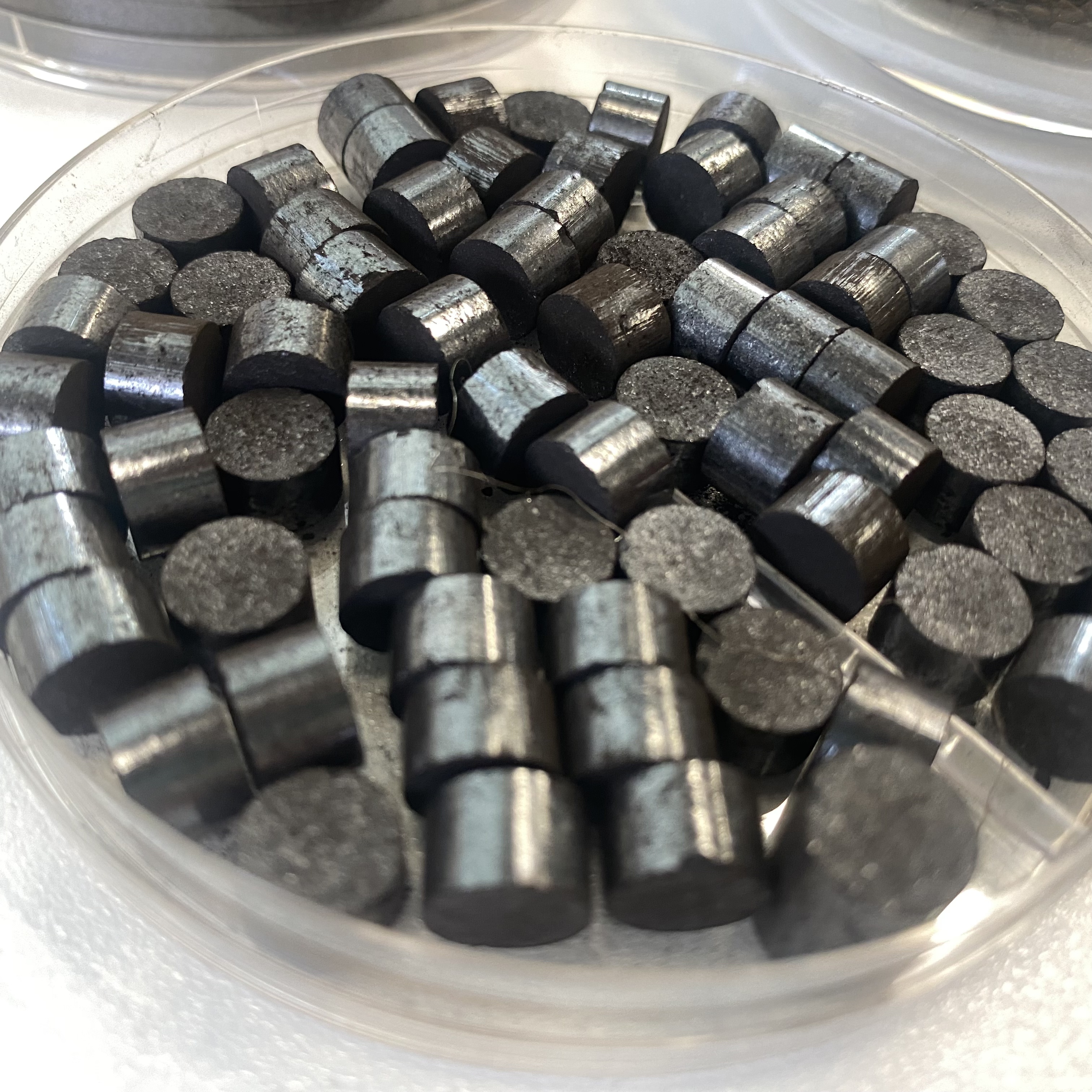
3. What role does the addition of manganese dioxide play? How does it work?
Manganese dioxide plays the role of a catalyst. A catalyst is a substance that can change the reaction rate in a chemical reaction while maintaining its own mass and chemical properties.
The principle of its application (i.e., catalytic mechanism) can be understood as "building a bridge" or "providing a shortcut":
Lowering the reaction energy barrier: Any chemical reaction requires overcoming an energy barrier (activation energy). Hydrogen peroxide molecules require a high activation energy to decompose on their own, resulting in a slow reaction. Manganese dioxide provides a new reaction pathway with lower activation energy.
Scientists believe that the manganese dioxide surface energy first reacts with hydrogen peroxide, decomposing it while temporarily reducing itself. It then quickly reacts with another hydrogen peroxide molecule, returning to its original state and releasing oxygen. This repetitive process greatly accelerates the rate of oxygen production.
A vivid metaphor is: we have a high mountain to climb (high activation energy), and climbing directly is very difficult (slow decomposition). The manganese dioxide catalyst is like a tunnel (a low-activation-energy path) that allows us to easily and quickly reach the other side of the mountain (generating oxygen).
Most amazingly, after creating this tunnel, the manganese dioxide itself remains intact, continuously "serving" thousands of hydrogen peroxide molecules. This is why, in experiments, only a small amount of manganese dioxide is needed to continuously produce large amounts of oxygen.
Using manganese dioxide as a catalyst, we can safely and efficiently produce oxygen from hydrogen peroxide at room temperature. This method is not only widely used in middle school chemistry labs but also has important applications in industrial production and medical disinfection (for example, generating oxygen flow or decomposing residual hydrogen peroxide). Understanding the principles of catalysis is crucial to our understanding and utilization of chemical reactions.
author: Hazel
date: 2025-09-25

 Skype
 WhatsApp
